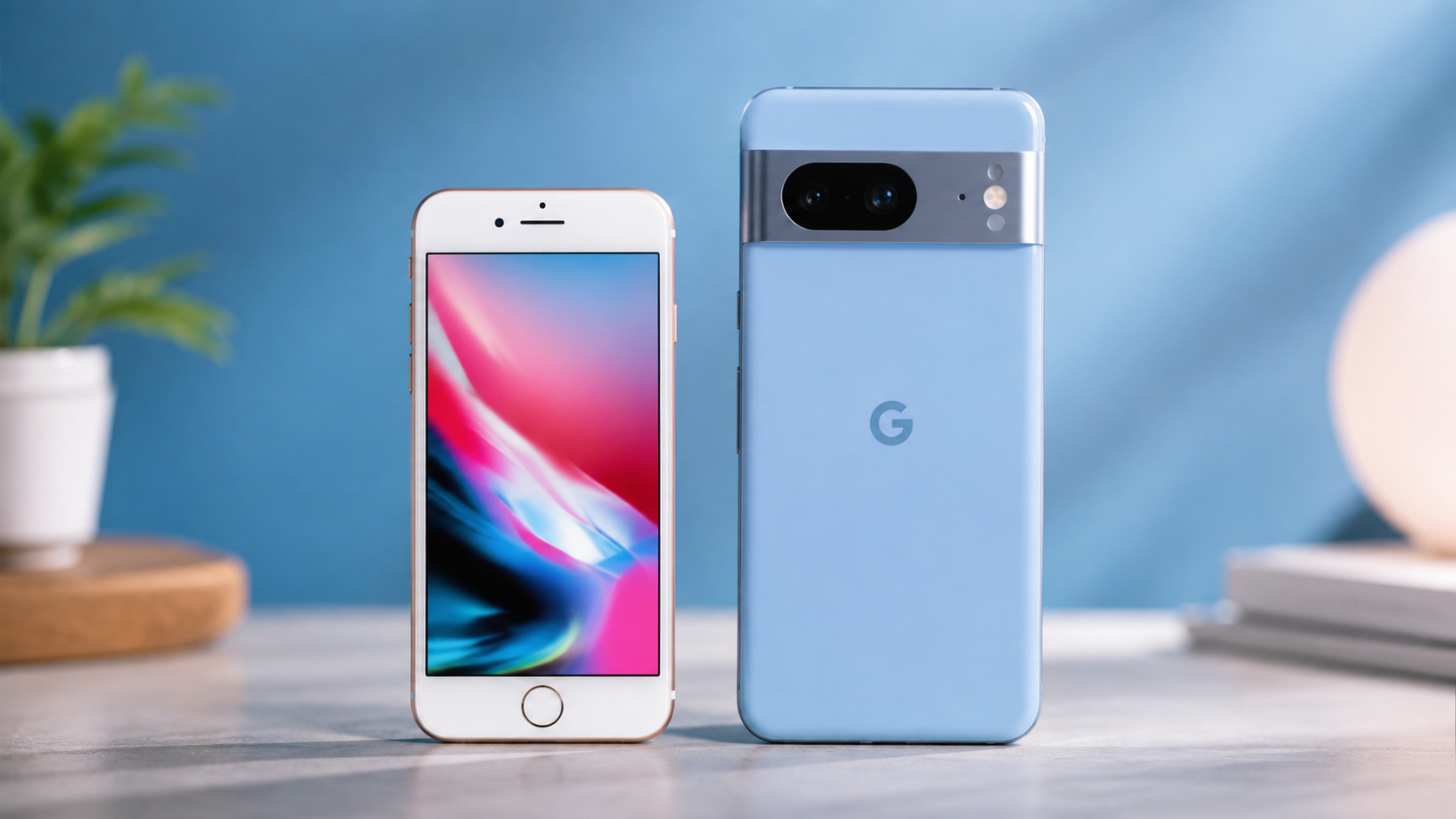
Iphone 8 andGoogle Pxial 8 Different
If you’re comparing the iPhone 8 and Google Pixel 8, the biggest difference is their age and overall technology. The iPhone 8 was introduced in 2017, while the Google Pixel 8 arrived in 2023. That six-year gap affects the display, cameras, processor, battery, connectivity, software support, and overall user experience.
The iPhone 8 is still attractive to people who prefer a small phone, Touch ID, iOS, and Apple’s traditional Home-button design. The Pixel 8, however, is much more modern, with a 6.2-inch OLED display, 5G, Tensor G3, a larger battery, advanced cameras, and Google’s long-term software-support commitment.
So, if you’re asking which is better between iPhone 8 and Pixel 8, the Pixel 8 is the clear choice for most buyers today. The iPhone 8 only makes more sense if you specifically want its compact design, iOS experience, or Touch ID.
iPhone 8 vs Google Pixel 8: Quick Comparison
| Feature | iPhone 8 | Google Pixel 8 |
|---|---|---|
| Release year | 2017 | 2023 |
| Display | 4.7-inch LCD | 6.2-inch OLED |
| Resolution | 1334 × 750 | 1080 × 2400 |
| Refresh rate | 60Hz | Up to 120Hz |
| Processor | Apple A11 Bionic | Google Tensor G3 |
| RAM | 2GB | 8GB |
| Storage | 64GB, 128GB, 256GB | 128GB, 256GB |
| Rear camera | 12MP single camera | 50MP + 12MP ultrawide |
| Front camera | 7MP | 10.5MP |
| Network | 4G LTE | 5G |
| Charging port | Lightning | USB-C |
| Wireless charging | Yes | Yes |
| Water resistance | IP67 | IP68 |
| Biometrics | Touch ID | Fingerprint + Face Unlock |
| Operating system | iOS | Android |
| Long-term update policy | Older device with limited major-iOS support | 7 years of OS and security updates |
The specifications show just how different these two phones are. Apple lists the iPhone 8 with a 4.7-inch LCD, A11 Bionic chip and IP67 rating, while Google’s Pixel 8 uses a 6.2-inch OLED display, Tensor G3 processor and IP68 protection.
Design and Build Quality
The iPhone 8 has Apple’s older design language. It uses a glass front and back with an aluminum frame and has a physical Home button containing Touch ID. Its compact 148-gram body is easy to hold and use with one hand.
The Pixel 8 has a much more modern appearance. It has a full-screen 6.2-inch display, a polished aluminum frame, Gorilla Glass Victus protection and a distinctive camera bar on the back. It weighs 187 grams.
Which design is better?
That depends on your preference.
Choose iPhone 8 if you want:
- A very compact phone
- A physical Home button
- Touch ID
- A lightweight design
- Apple’s traditional iPhone appearance
Choose Pixel 8 if you want:
- A modern full-screen design
- A larger display
- USB-C
- A newer build
- Better water and dust resistance
The Pixel 8 has an IP68 rating, while the iPhone 8 has IP67 protection. Neither should be treated as permanently waterproof because water resistance can decrease with normal wear, damage, or repairs.
Display Difference
This is one of the most obvious differences.
The iPhone 8 has a 4.7-inch Retina HD LCD with a 1334 × 750 resolution and 326 pixels per inch. It also supports True Tone and Apple’s wide color display.
The Pixel 8 has a much larger 6.2-inch OLED display with a 1080 × 2400 resolution, 428 PPI and a 60–120Hz Smooth Display. Google also rates it for up to 2,000 nits of peak brightness.
Pixel 8 has the better display
For watching YouTube, browsing websites, viewing photos, gaming and reading, the Pixel 8 is significantly better.
Its OLED panel provides deeper blacks and stronger contrast, while the 120Hz capability can make scrolling and supported animations feel smoother.
The iPhone 8’s smaller display can still be an advantage if you dislike large phones.
Performance: A11 Bionic vs Tensor G3
The iPhone 8 uses Apple’s A11 Bionic chip. For its time, the A11 was a powerful mobile processor, and it helped the iPhone 8 remain capable for years. Apple also included a Neural Engine in the device.
The Pixel 8 uses Google’s Tensor G3 processor with 8GB of LPDDR5X RAM and a Titan M2 security coprocessor.
Which phone is faster?
The answer isn’t simply about benchmark numbers.
The Pixel 8 is the much newer platform and is designed around modern Android features, AI processing and current connectivity. The iPhone 8’s A11 remains capable for basic tasks, but the phone’s age limits its usefulness as a modern smartphone.
For everyday activities such as:
- Social media
- Web browsing
- Video streaming
- Photography
- Modern apps
- Multitasking
the Pixel 8 is the better long-term choice.
[Internal Link: Best Android Phones for Everyday Use]
Camera Comparison
Camera hardware is another major difference.
The iPhone 8 has a single 12MP wide rear camera with an f/1.8 aperture and optical image stabilization. Its front camera is 7MP.
The Pixel 8 has a 50MP main camera and a 12MP ultrawide camera. It also has a 10.5MP front camera. Google’s camera system includes features such as Super Res Zoom and optical/electronic stabilization.
Pixel 8 is better for photography
The Pixel 8 benefits from both newer hardware and Google’s computational photography.
It is particularly attractive if you want:
- Better low-light photography
- An ultrawide camera
- Modern image processing
- AI-powered photography features
- Better flexibility for different types of shots
The iPhone 8 can still take good photos in suitable lighting, but its camera hardware is from a much older generation.
Battery and Charging
Battery technology is another area where the Pixel 8 has a major advantage.
Google lists the Pixel 8 with a typical 4,575mAh battery, fast charging, Qi-certified wireless charging and Battery Share. Google says it can provide more than 24 hours of battery life under its stated testing conditions, with Extreme Battery Saver capable of extending this further.
Apple does not market the iPhone 8 using the same mAh comparison in its official specifications. The phone supports wired charging and Qi wireless charging. Apple specifically states that iPhone 8 and later models support integrated Qi wireless charging.
Pixel 8 wins for battery
If battery life is important, the Pixel 8 is the better option.
One important point when buying a used iPhone 8 is battery health. Because the phone is an older model, the condition of its original battery can vary considerably between individual devices.
Software: iOS vs Android
The software experience is fundamentally different.
The iPhone 8 runs Apple’s iOS ecosystem, while the Pixel 8 uses Google’s Android ecosystem.
The iPhone 8 originally launched with iOS 11 and remained supported for several major iOS generations. It was compatible with iOS 16, but Apple’s current iOS 26 compatibility list does not include the iPhone 8.
The Pixel 8 launched with Android 14 and Google committed to seven years of OS, security and Pixel Drop updates starting from when the device first became available on the Google Store in the United States.
Pixel 8 has the major software-support advantage
This is one of the most important reasons to choose the Pixel 8 in 2026.
The Pixel 8 was designed for a much longer modern software lifecycle. Google explicitly committed to seven years of updates for the Pixel 8 series.
By comparison, the iPhone 8 is now an older device and is not included among the iPhones compatible with Apple’s current iOS 26 release.
4G vs 5G
Connectivity is another important difference.
The iPhone 8 is a 4G LTE phone. The Pixel 8 supports 5G, with supported bands varying by model and market.
If you’re buying a phone for use over the next few years, 5G can make the Pixel 8 a more practical choice where compatible 5G networks are available.
For users in areas where 5G coverage is limited, this difference may be less noticeable.
Storage Options
The iPhone 8 was sold with 64GB, 128GB and 256GB storage options.
The Pixel 8 comes with 128GB or 256GB storage.
Neither phone provides a microSD card slot for expandable storage, so it’s important to choose enough internal storage for your apps, photos and videos.
Security and Biometrics
The iPhone 8 uses Touch ID, allowing you to unlock the phone and authenticate using your fingerprint.
The Pixel 8 offers both fingerprint unlocking and Face Unlock. Google also uses its Titan M2 security coprocessor as part of the device’s security architecture.
If you specifically prefer a physical fingerprint sensor and Home button, the iPhone 8 has a unique advantage.
If you prefer a modern biometric system and newer security architecture, the Pixel 8 is more advanced.
iPhone 8 vs Pixel 8: Which Is Better for Gaming?
The Pixel 8 is the better choice for someone buying a phone specifically for modern gaming.
It has:
- A newer processor
- More RAM
- A larger OLED display
- A 120Hz display capability
- A larger battery
The iPhone 8’s A11 Bionic was powerful for its generation, but the hardware is now considerably older.
For casual games, the iPhone 8 can still be usable if the game supports its software version. For demanding modern games, the Pixel 8 is the safer choice.
Which Phone Is Better for Photography?
Pixel 8 wins.
Its 50MP main camera, ultrawide camera and Google’s computational photography provide a much more modern camera experience.
The iPhone 8’s 12MP camera can still produce pleasant photographs, especially in good lighting, but it lacks the flexibility and modern processing of the Pixel 8.
[Internal Link: How to Take Better Photos With an Android Phone]
Which Phone Is Better for Small-Phone Lovers?
iPhone 8 wins for compactness.
The iPhone 8 has a 4.7-inch display and weighs 148 grams.
The Pixel 8 is still relatively compact by modern standards, but its 6.2-inch display and 187-gram weight make it noticeably larger.
If your priority is a small phone that you can comfortably operate with one hand, the iPhone 8’s physical size is its strongest advantage.
Which Phone Should You Buy in 2026?
For most people, the answer is Google Pixel 8.
The Pixel 8 offers a newer processor, modern OLED display, 5G, better camera hardware, USB-C, larger battery capacity, IP68 protection and a seven-year software-support commitment.
The iPhone 8 can still be considered if:
- You specifically want iOS
- You prefer Touch ID
- You want a very small phone
- You already have Apple accessories and services
- You find a clean used unit at a very low price
However, buying an iPhone 8 in 2026 requires more consideration because it is an older device and is not compatible with Apple’s current iOS 26 release.
Pros and Cons
iPhone 8 Pros
- Very compact and lightweight
- Touch ID
- Familiar iOS experience
- Wireless charging
- Good build quality
- Still suitable for basic everyday tasks when supported by apps
iPhone 8 Cons
- Much older hardware
- Small LCD display
- No 5G
- Single rear camera
- Smaller battery
- No USB-C
- Not supported by the current iOS 26 release
Pixel 8 Pros
- Modern 6.2-inch OLED display
- Up to 120Hz refresh rate
- Tensor G3 processor
- 8GB RAM
- 50MP main camera plus ultrawide
- 5G
- USB-C
- Larger battery
- IP68 protection
- Seven years of OS and security updates
Pixel 8 Cons
- Larger and heavier than iPhone 8
- Android may not suit users who prefer iOS
- Some Google AI features can depend on language, country, account or other requirements
- Availability and pricing can vary by market
Frequently Asked Questions
Is Google Pixel 8 better than iPhone 8?
Yes. For most buyers, the Pixel 8 is much better because it is six years newer and offers a better display, cameras, battery, connectivity and long-term software support.
Is iPhone 8 still worth buying?
It can be worth buying as a very inexpensive used phone for basic use, especially if you want Touch ID and a compact iPhone. However, it is not a good choice for someone looking for long-term software support.
Which has the better camera, iPhone 8 or Pixel 8?
The Pixel 8 has the more advanced camera system. It includes a 50MP main camera and 12MP ultrawide camera, while the iPhone 8 has a single 12MP rear camera.
Does Pixel 8 have 5G?
Yes. The Pixel 8 supports 5G, although exact network-band compatibility depends on the model and market.
Does iPhone 8 have 5G?
No. The iPhone 8 is a 4G LTE device.
Which has a better display?
The Pixel 8 has the better display. It uses a 6.2-inch OLED panel with a 60–120Hz refresh range, while the iPhone 8 uses a 4.7-inch 60Hz-class LCD display.
Which phone has better battery life?
The Pixel 8 has the more modern and substantially larger battery hardware. Google lists a typical 4,575mAh battery and more than 24 hours of estimated battery life under its testing conditions.
Does iPhone 8 support wireless charging?
Yes. Apple states that iPhone 8 and later models support Qi-certified wireless charging.
How long will Google Pixel 8 get updates?
Google committed to seven years of OS and security updates, plus Pixel Drops, starting from the Pixel 8’s availability on the Google Store in the United States.
Final Verdict
The iPhone 8 and Google Pixel 8 are very different phones despite having similar names.
The iPhone 8 is a compact older iPhone designed around Apple’s traditional Home-button experience. Its strongest advantages are its small size, Touch ID and iOS ecosystem.
The Pixel 8 is the much more modern device. Its OLED display, Tensor G3 processor, 50MP camera system, 5G, USB-C, larger battery and seven-year update commitment make it the stronger choice for most people buying a phone today.
Overall winner: Google Pixel 8.
If your priority is small size and Touch ID, consider the iPhone 8. If your priority is modern hardware, camera quality, battery, display and long-term use, choose the Pixel 8.
Sources & Further Reading
- Apple — iPhone 8 Technical Specifications
- Apple — iPhone models compatible with iOS 26
- Google — Pixel 8 hardware specifications
- Google — Pixel 8 seven-year software-support commitment
- Google — Pixel software-update policy